

What is Lipoedema?
Lipoedema is a chronic condition characterised by a build-up of abnormal fat and loose connective tissue, primarily in the legs, but can also affect the arms and buttocks.
Lipoedema almost exclusively affects women, leading to considerable disability, daily functioning impairment, and psychosocial distress. Despite the clinical impact on women's health, lipoedema is in fact mostly unknown, underdiagnosed, and too often misdiagnosed with other similarly presenting diseases.
Lipoedema can cause pain, swelling, and bruising, and can impact mobility. There's no cure for lipoedema, but management strategies include conservative measures like compression therapy, exercise therapies that are low impact and improve lymphatic drainage and through eating anti-inflammatory, low carb or keto diets.
Lipoedema is not yet well researched, though research is increasing and gaining momentum. While there's a growing body of knowledge, several aspects of lipoedema remain poorly understood, making diagnosis and treatment challenging and expensive.
The Lipoedema Wellness Centre Brisbane will be the first specialised wellness centre in Australia focused exclusively on providing non-judgmental, evidence-based support for women living with lipoedema. Offering a multidisciplinary approach, including medical diagnosis, hydrotherapy, Pilates, lymphatic massage, strength training, compression garment fittings, and education workshops, it will empower women to manage their health holistically.
There is an estimated 55,000+ women in the inner Brisbane region live with symptoms of lipoedema, a vastly under-served market. With growing awareness and zero local centres focused solely on this condition, we aim to be the trusted leader in this emerging healthcare niche.
Lipoedema almost exclusively affects women, leading to considerable disability, daily functioning impairment, and psychosocial distress. Despite the clinical impact on women's health, lipoedema is in fact mostly unknown, underdiagnosed, and too often misdiagnosed with other similarly presenting diseases.
Lipoedema can cause pain, swelling, and bruising, and can impact mobility. There's no cure for lipoedema, but management strategies include conservative measures like compression therapy, exercise therapies that are low impact and improve lymphatic drainage and through eating anti-inflammatory, low carb or keto diets.
Lipoedema is not yet well researched, though research is increasing and gaining momentum. While there's a growing body of knowledge, several aspects of lipoedema remain poorly understood, making diagnosis and treatment challenging and expensive.
The Lipoedema Wellness Centre Brisbane will be the first specialised wellness centre in Australia focused exclusively on providing non-judgmental, evidence-based support for women living with lipoedema. Offering a multidisciplinary approach, including medical diagnosis, hydrotherapy, Pilates, lymphatic massage, strength training, compression garment fittings, and education workshops, it will empower women to manage their health holistically.
There is an estimated 55,000+ women in the inner Brisbane region live with symptoms of lipoedema, a vastly under-served market. With growing awareness and zero local centres focused solely on this condition, we aim to be the trusted leader in this emerging healthcare niche.

Stages and Types
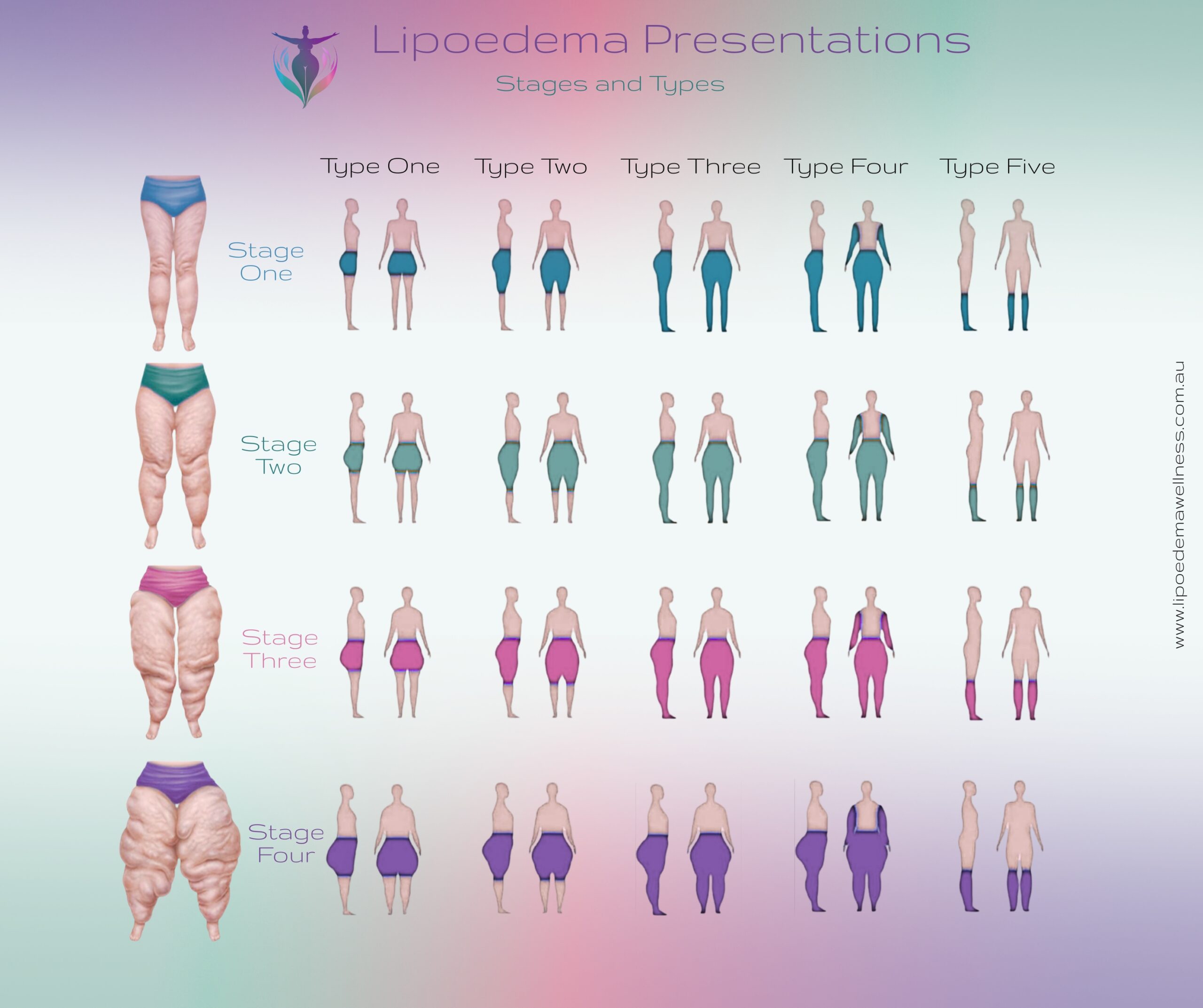
Lipoedema develops in stages and the level of pain, tenderness, swelling and fat accumulation may increase. The symptoms and pain associated with lipoedema may be mild, moderate or severe throughout all of the stages. The presentation of Lipoedema can vary from person to person, there are going to be significant differences in someone who presents with Type 1 (affecting bum and hips) and Type 5 (affecting the calves / lower legs). That is without getting into the stages. Two people who both have Type 3 and Stage 3, can present differently and their bodies can be affected in different ways at each stage.
The stages of lipoedema are descriptive of the appearance of lipoedema and are somewhat descriptive of the tissue progression, but do not fully describe the severity of the lipoedema condition.
Stage One: In the early stage of lipoedema, individuals may experience a smooth appearance of the skin in the affected areas. There is an increase in fat accumulation around the pelvis, buttocks, and hips. Swelling worsens throughout the day but typically resolves with rest and elevation.
Stage Two: In the mid-stages of lipoedema, the skin develops indentations, and the subcutaneous tissue feels tougher and more nodular. Lipomas, or fatty lumps, may be present. Fat build-up becomes more noticeable on the upper and lower legs, extending towards the ankles. Swelling is often more significant in this stage. Swelling is less affected by rest and elevation compared to Stage 1.
Stage Three: Advance stage lipoedema, there is further hardening of connective tissues and persistent swelling that does not resolve with rest and elevation. Large masses of fat cause thigh and knee deformations, impacting mobility and quality of life. This stage may also be associated with the development of secondary lymphedema or secondary obesity. Stage 3 lipoedema has the highest rate of orthopaedic complications.
Stage Four: Now referred to as Lipolymphedema. Development of lipolymphedema — a condition where both Lipoedema and lymphedema are present in the body — with large overhangs of tissue on legs and/or arms.
The stages of lipoedema are descriptive of the appearance of lipoedema and are somewhat descriptive of the tissue progression, but do not fully describe the severity of the lipoedema condition.
Stage One: In the early stage of lipoedema, individuals may experience a smooth appearance of the skin in the affected areas. There is an increase in fat accumulation around the pelvis, buttocks, and hips. Swelling worsens throughout the day but typically resolves with rest and elevation.
Stage Two: In the mid-stages of lipoedema, the skin develops indentations, and the subcutaneous tissue feels tougher and more nodular. Lipomas, or fatty lumps, may be present. Fat build-up becomes more noticeable on the upper and lower legs, extending towards the ankles. Swelling is often more significant in this stage. Swelling is less affected by rest and elevation compared to Stage 1.
Stage Three: Advance stage lipoedema, there is further hardening of connective tissues and persistent swelling that does not resolve with rest and elevation. Large masses of fat cause thigh and knee deformations, impacting mobility and quality of life. This stage may also be associated with the development of secondary lymphedema or secondary obesity. Stage 3 lipoedema has the highest rate of orthopaedic complications.
Stage Four: Now referred to as Lipolymphedema. Development of lipolymphedema — a condition where both Lipoedema and lymphedema are present in the body — with large overhangs of tissue on legs and/or arms.